
From Noise to Nuance: Mastering Modern Alerts
Transform overwhelming alarm fatigue into streamlined situational awareness with role-based notifications that ensure the right information reaches the right person at the right time.
2/10/20263 min read
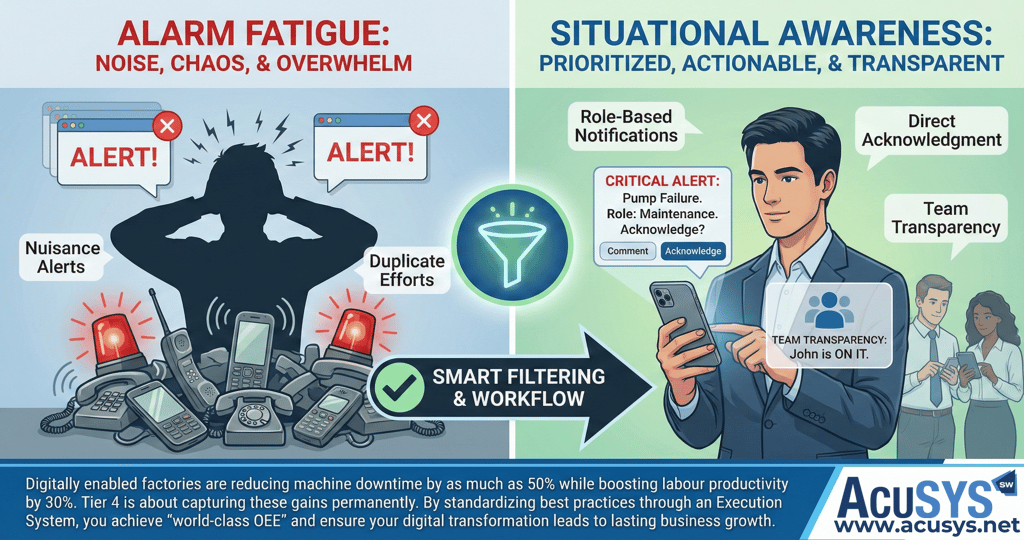
Situational Awareness, Not Alarm Fatigue: Turning Critical Alerts into Tools
In the high-pressure environment of a modern industrial plant, "alarm fatigue" is more than a buzzword—it’s a safety and productivity risk. When every sensor on the floor triggers a generic siren or a notification on a central terminal, technicians often find themselves drowning in a "nuisance" of alerts rather than receiving actionable tools.
Tier 2 (Monitoring & Control) is the interaction layer where human expertise meets industrial data. Preparing for an AI-integrated operation requires moving beyond static sirens toward a system that provides situational awareness: getting the right information to the right person at the exact time they can act on it.
Here is how specific software solutions transform critical alerts from distractions into high-value diagnostic tools.
1. Eliminating the Noise with Alarm Rationalization
Before an alert hits your smartphone, it needs to be validated. A "chattering" or "stale" alarm that triggers 100 times an hour is a distraction, not a tool.
Software Solution: ProcessVue
How it helps: ProcessVue acts as an alarm management suite and "Sequence of Events" (SOE) analyser. It continuously benchmarks your system against global standards like ISA-18.2 to identify "bad actor" alarms. By filtering out nuisance alarms and presenting clear, prioritized information, ProcessVue ensures that when your phone pings, it is for a genuine process deviation that requires your expertise.
2. Multi-Channel, Role-Based Delivery
A critical alert shouldn't wake up a technician who is off-duty, and it shouldn't be missed by the one standing next to the machine. Modern systems prioritize notifications based on specific shift schedules and organizational roles.
Software Solution: WIN-911
How it helps: WIN-911 is the industry standard for remote alarm notification. It delivers alerts via SMS, email, or voice calls. Crucially, it uses escalation chains: if the primary technician on shift doesn't acknowledge an alarm within a set timeframe, the system automatically routes it to the next person in the chain. This ensures 24/7 coverage without overwhelming staff who aren't currently on the floor.
3. Smartphone Interaction and Team Transparency
Transparency is the antidote to duplicate effort. When a technician acknowledges an alarm on their phone, the entire team should instantly know that the issue is being handled.
Software Solution: SmartSights Mobile (formerly Mobile-911)
How it helps: SmartSights provides a real-time job queue on your smartphone. Technicians can acknowledge alarms and add comments directly from the app. This bi-directional communication ensures that the control room and other field techs see exactly who has taken ownership of a task, preventing three people from running to the same pump while another issue goes unnoticed.
4. Native Web Visualization for Instant Context
Receiving a text that "Pressure is High" is helpful, but seeing the live pressure curve on a trend plot is situational awareness.
Software Solution: atvise® SCADA
How it helps: Because atvise is 100% web-based, technicians can access the full HMI/SCADA interface from any standard browser on their smartphone—no additional software required. With native HTML5 and vector graphics (SVG), the screens scale perfectly to your phone's resolution. You can "drill down" into the alarm hierarchy to see the process state leading up to the alert, giving you the context needed to fix the problem on the first try.
The Bottom Line: Moving from Reactive to Proactive
By combining these tools, your facility moves from a reactive culture of "responding to sirens" to a proactive model of "managing by exception." Technicians gain the freedom to move throughout the plant without losing visibility, and directors gain the peace of mind that critical events are handled by the right people, every time.
Summary: This blog post explains how to transition from industrial alarm fatigue to true situational awareness within the Monitoring & Control layer. It describes how ProcessVue filters out nuisance noise, WIN-911 routes alerts according to schedules, and SmartSights Mobile and atvise provide the mobile transparency and web-native visualization needed for technicians to act decisively from their smartphones.
Copyright 2026 AcuSYS Software Solutions (Pty) Ltd. All Rights Reserved.