
Digitising Tribal Knowledge: The Power of the Visual Logbook
Turn raw industrial data into a searchable asset by allowing your team to annotate trend plots with real-world solutions, ensuring the "how-to" of every fix is never lost.
2/17/20262 min read
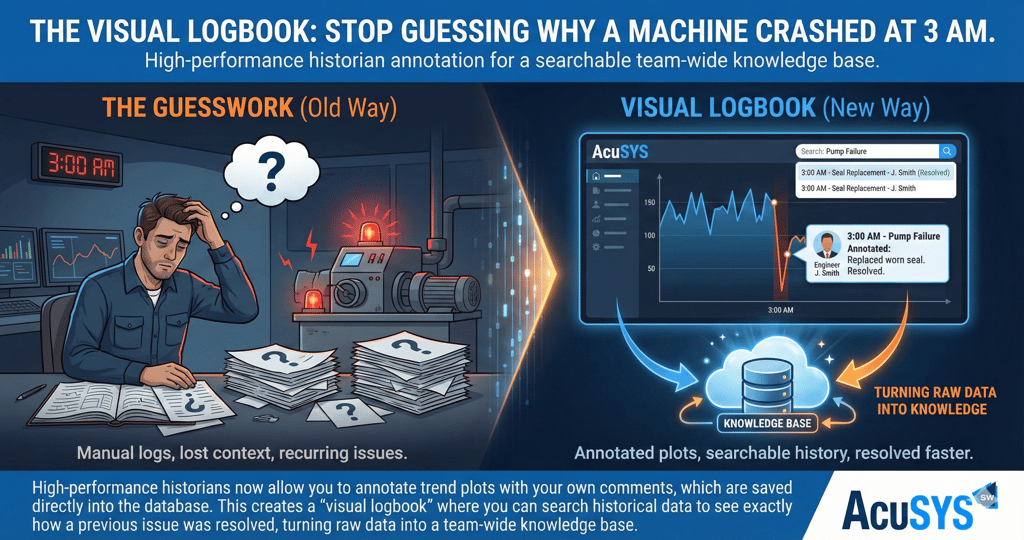
Stop the 3 AM Guessing Game: How the Visual Logbook Turns Data into Shop Floor Expertise
Every technician knows the sinking feeling of walking into a 3 AM machine crash with no record of what happened. You’re left staring at a deadline, wondering if this has happened before and, more importantly, how it was fixed. Traditionally, the only record was a coffee-stained paper log or a mental note from a colleague who’s currently asleep.
Industrial AI and automation readiness require a shift from this "guesswork" to a team-wide knowledge base. The key is turning your raw data into a Visual Logbook that lives directly within your process trends.
The Problem: Lost Context and Tribal Knowledge
Manual data entry and paper-based logs are the primary bottlenecks in modern maintenance. When information is entered manually, mistakes happen, updates are delayed, and technicians waste hours searching through files instead of performing actual repairs. Furthermore, when key staff leave or shift change, the "tribal knowledge" of how to fix specific anomalies often evaporates, forcing the next technician to reinvent the wheel.
The Solution: CCi Historian
The foundation of a visual logbook is a high-performance historian that can handle the sheer volume of data produced by modern operations. CCi Historian (Cake) is designed specifically for this, capable of storing over a million tags and retrieving history at a rate of 70 million values per second—often 10 to 1,000 times faster than standard relational databases.
How it creates the Visual Logbook: The heart of the system is the CCI Plot feature. While most historians just show you a line on a graph, CCi Historian allows you to annotate trend plots with your own comments.
Searchable History: When a machine trips, you can add a time-stamped comment directly onto the trend line explaining the cause and the fix.
Contextual Retrieval: These annotations are saved directly into the historian database. Months later, another technician can search for and recall those comments, seeing the exact process conditions (temperature, pressure, vibration) that existed when the note was written.
Golden Batch Comparison: Technicians can overlay current data with a "golden batch" or a previous successful run to see exactly where the process deviated, using the logbook to understand past adjustments.
Scaling Insights with XLReporter and SmartSights
To ensure these insights reach the right people beyond the shop floor, the visual logbook integrates seamlessly with other diagnostic tools:
XLReporter: This solution can automatically pull the annotated data and raw values to create shift reports and compliance documents, ensuring that the "fix" is documented for management without additional manual entry.
SmartSights: By using the OneView dashboard, managers can see these high-level KPIs and annotations across multiple sites, allowing for cross-plant collaboration on recurring issues.
The Bottom Line
By moving to a digital visual logbook, you eliminate the "paper chase" and ensure that the solution to a 3 AM crash is always just a search away. This turns your historian from a passive storage bin into an active team-wide knowledge base that drives faster incident response and improves overall equipment effectiveness (OEE).
Summary: This blog post explains how technicians can use CCi Historian to eliminate the guesswork of machine failures. By utilizing the CCI Plot annotation feature, technicians can create a "visual logbook" where comments and fixes are saved directly into the time-series database. This ensures that critical troubleshooting knowledge is preserved and searchable, replacing manual systems that lead to errors and downtime. Combined with XLReporter and SmartSights, this data provides a continuous overview of production that empowers the entire team to resolve issues faster.
Copyright 2026 AcuSYS Software Solutions (Pty) Ltd. All Rights Reserved.