
Beyond the Gut Feel: Decoding Your Production DNA
Move from intuitive management to data-driven precision by using high-speed time-series analysis to uncover the micro-stoppages that traditional OEE reporting often misses.
2/18/20262 min read
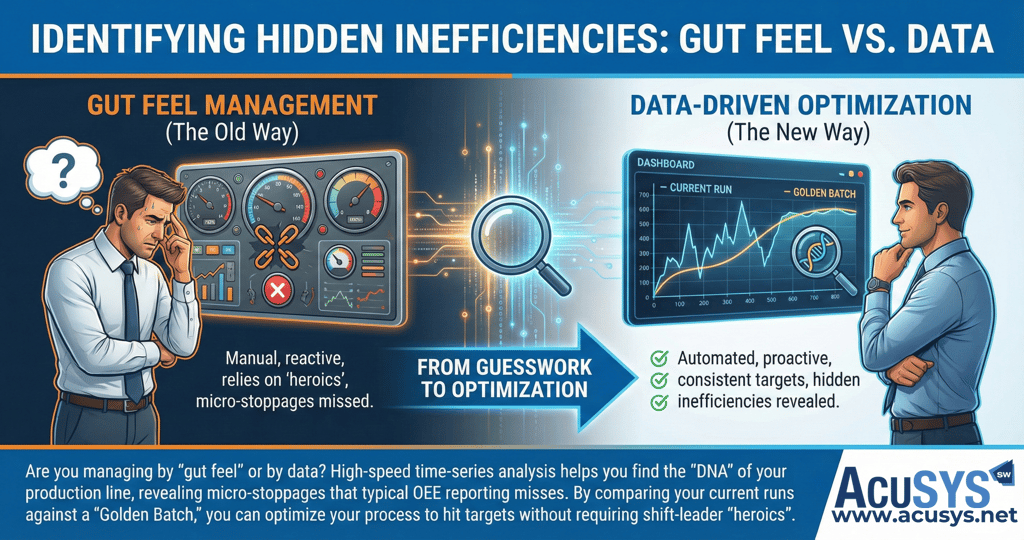
Beyond "Gut Feel": Decoding Your Production Line’s DNA for Consistent OEE
As a mid-level manager, your performance is often measured by your team’s ability to hit production targets. But how often are those targets achieved through sheer "shift-leader heroics"—a specific supervisor’s "magic touch" or a crew working overtime to compensate for a machine that "just feels off"?
Managing by gut feel is common, but it’s a major obstacle to AI readiness. Operational efficiency suffers when you cannot see the "DNA" of your production line—the tiny, recurring micro-stoppages and process drifts that traditional reporting often misses.
Here is how data-driven analytics helps you move from reactive firefighting to proactive optimization.
1. High-Speed Historization: Seeing the Micro-Stops
Typical data collection might capture a 20-minute breakdown, but it often misses the three-second "stutters" that happen 50 times an hour. These micro-stops are the hidden profit killers. To identify them, your facility needs a high-performance historian capable of retrieving tens of millions of values per second. This speed allows you to visualize the high-resolution "DNA" of your equipment, revealing exactly where a process is losing its rhythm.
2. Comparing Current Runs to the "Golden Batch"
One of the most powerful tools in your management toolkit is the ability to compare different time frames. By overlaying your current production data against a "Golden Batch"—your fastest, highest-quality run ever recorded—you can immediately see where deviations are occurring.
Contextual Insight: Instead of just knowing your OEE is low, you can identify that a specific temperature fluctuation or feed rate inconsistency is causing the lag.
Digital Replay: Advanced digital twin technology allows you to "fast-forward, rewind, and pause" through production sequences. If a line crashed last night, you can replay the sensor data in sync to diagnose the root cause without having to guess based on second-hand reports.
3. Higher OEE Without the "Heroics"
True operational excellence is about standardizing best practices so that every shift is your best shift. When you use an analytics accelerator to group your KPIs into themed views, you empower your supervisors with real-time access to relevant metrics.
Scenario Planning: Use "what-if" tools and sliders to simulate production scenarios. You can see the impact of a rush order or a machine slowdown on your OEE in real-time, allowing you to make dynamic schedule adjustments based on fact, not intuition.
Embedded Knowledge: By standardizing workflows and using data to guide operators, you ensure that improvements are maintained across different crews, eliminating the need for specific individuals to perform "heroics" to hit the day’s goals.
4. Moving from Reactive to Proactive
When your data is contextualized and governed, you can move beyond simply tracking what happened to predicting what will happen. By monitoring equipment conditions and energy consumption patterns, your system can generate alerts for anomalies that indicate a machine will break down long before it actually stops the line.
The Bottom Line: Transitioning from "gut feel" to high-fidelity analytics allows you to identify hidden inefficiencies, reduce operator stress, and achieve world-class OEE (85%+) through consistent, data-driven execution.
Summary: This blog post helps mid-level managers move from intuitive to data-driven decision-making by explaining the value of Tier 3 Data Management and Analytics. It describes how high-performance historians and digital twin technology help identify the "DNA" of production lines and micro-stoppages that traditional OEE reports miss. By comparing current runs to a "Golden Batch" and utilizing real-time scenario planning, managers can achieve consistent, high-performance results across all shifts without requiring manual "heroics".
Copyright 2026 AcuSYS Software Solutions (Pty) Ltd. All Rights Reserved.