
World-Class OEE: Making Massive Efficiency Gains Permanent
Learn how to lock in 50% downtime reductions and 30% productivity boosts by standardizing high-level execution systems across your entire manufacturing enterprise.
2/27/20262 min read
Scaling Excellence: How Tier 4 Governance Captures Permanent Gains
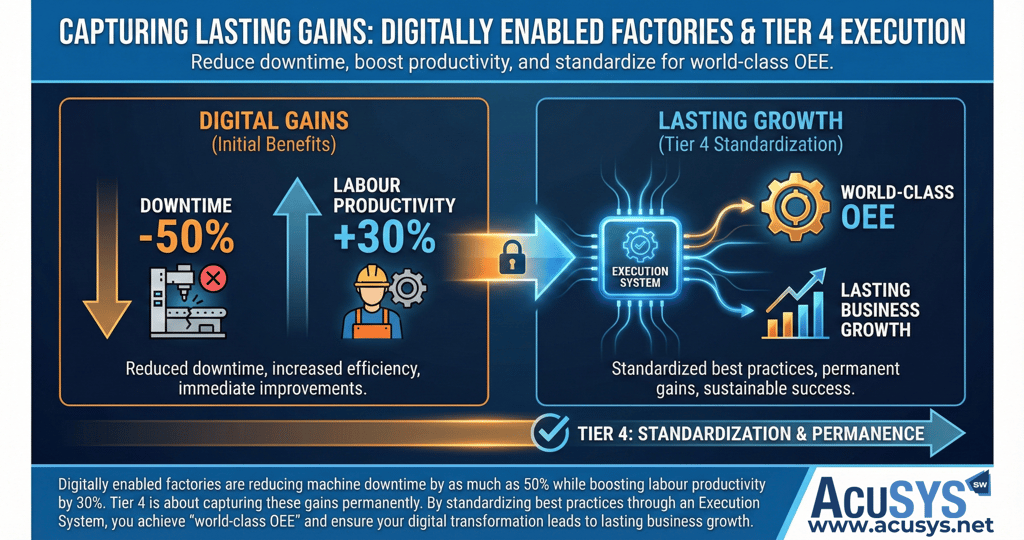
For industrial directors and top-level managers, the promise of digital transformation is often expressed in two powerful statistics: a 50% reduction in machine downtime and a 30% boost in labour productivity. However, the real challenge isn't achieving these gains during a pilot program—it’s capturing them permanently and scaling them across the entire enterprise.
Tier 4 (Operations & Governance) is the layer where digital strategy meets operational reality. It is the bridge that turns a fragmented digital ecosystem into a resilient, autonomous enterprise by standardizing best practices and safeguarding the "digital core".
Here is how our software solutions help you capture lasting gains and move toward "world-class" OEE.
1. Orchestrating Best Practices with TrakSYS (MES)
A Manufacturing Execution System (MES) is the operating model for the modern factory. Without it, improvements often rely on "shift-leader heroics"—individual expertise that disappears when a specific supervisor leaves or a shift changes.
How it helps: TrakSYS synchronizes production planning with shop-floor execution in real-time. It enforces standard operating procedures (SOPs) and provides digital work instructions, ensuring that every operator adheres to the most efficient process every time. By measuring performance against "faceplate" ratings—the theoretical maximum speed of your equipment—TrakSYS provides a fair, transparent view of where productivity is truly lost, preventing "OEE cheating" and driving genuine growth.
2. Safeguarding the Digital Core with octoplant
As your facility becomes more complex, the risk of "logic drift"—unauthorized or accidental changes to your control systems—increases. If you improve a process today, you must ensure that improvement isn't lost tomorrow due to a hardware failure or a human error.
How it helps: octoplant serves as your operational safety net by providing automated backups and version control for your entire automation landscape (PLCs, robots, SCADA, and more). It tracks "who changed what, when, and why," providing a defensible audit trail and ensuring that if a disruption occurs, you can restore the "approved version" of your process in minutes. This resilience protects your ROI and supports compliance with global standards like NIS2.
3. Analyzing the "DNA" of Production with CCi Historian
To scale gains across multiple plants, you need high-fidelity data that reveals why one line outperforms another
How it helps: CCi Historian is built for high-performance time-series data, retrieving history at a rate of 70 million values per second—up to 1,000 times faster than general-purpose historians. This allows you to uncover the "DNA" of your production line, identifying the micro-stoppages and process drifts that traditional reporting misses. By integrating directly with Python-based machine learning tools, it provides the foundation for real-time anomaly detection and predictive maintenance modeling.
4. Enterprise-Wide Visibility with atvise®
Oversight shouldn't be limited by geography or hardware. Directors need a "single pane of glass" view of global operations.
How it helps: atvise® SCADA is 100% web-native, utilizing HTML5 and SVG standards to deliver high-definition dashboards to any device, anywhere. It breaks down "islands of automation" by consolidating data from disparate sources into a unified interface. This transparency ensures that top-level management can monitor site performance and catch "slips" in OEE before they impact the annual bottom line.
The Bottom Line: Moving Toward Autonomy
Tier 4 is not just about monitoring; it’s about governance. By combining TrakSYS, octoplant, CCi Historian, and atvise, you create a resilient framework where data-driven decisions become part of the daily operating culture. This is how manufacturers turn complex digital transformations into lasting gains and achieve a competitive advantage that scales.
Copyright 2026 AcuSYS Software Solutions (Pty) Ltd. All Rights Reserved.