The R 1 350 000 Hour: Closing the Connectivity Gap
Learn how a standardized data core mitigates the massive financial risk of unplanned outages while building a scalable foundation for future-ready industrial models.
2/5/20263 min read
The R1 350 000 Hour: Why a Disconnected Facility is Your Biggest Strategic Risk
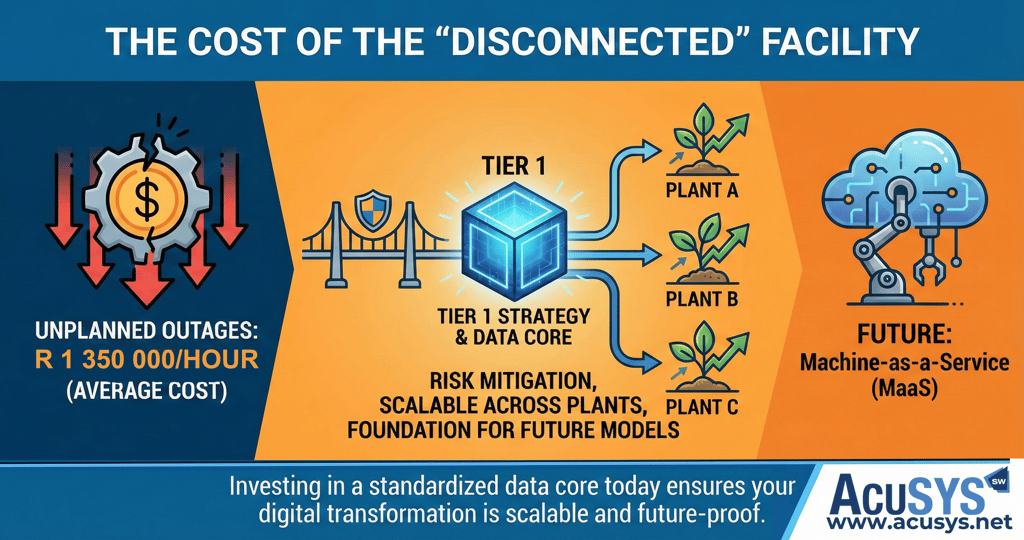
For the modern director, the "cost of doing business" is being redefined by a startling statistic: unplanned outages now cost mid-sized industrial businesses an average of R1 350 000 per hour. When operations are spread across multiple plants and geographies, a disconnected digital ecosystem doesn't just hinder efficiency—it creates a fragmented landscape of slow response cycles, inconsistent quality, and inaccurate planning models.
Preparing for AI is not a luxury; it is a risk mitigation strategy. By investing in a standardized Tier 1 data core today, you transform your facility from a series of "islands of automation" into a scalable, resilient enterprise ready for future business models like Machine-as-a-Service.
The Strategic Blueprint for Resilience
To move from a reactive stance to a proactive one, directors must coordinate investment priorities across the enterprise to ensure the foundations of data and resilience are sound. This requires a four-step approach to digital architecture:
1. Liberate the Data Core
Innovation is often throttled by "technical debt," with 70% to 80% of IT budgets spent simply keeping legacy systems alive.
How our solutions help: Tools like TANI PLC Engine and OAS (Open Automation Software) serve as the first mile of connectivity, speaking the language of legacy hardware (like Siemens S5 or Modbus) and translating it into modern, secure OPC UA or MQTT streams. By using OPC Router, you can then utilize visual, no-code workflows to push this data into SAP, ERP, or cloud AI lakes without the need for expensive, bespoke coding.
2. Establish Enterprise-Wide Visibility
Resilience depends on a "single pane of glass" view that allows plant managers to detect disruptions early and recalibrate plans instantly.
How our solutions help: atvise® SCADA and SmartSights (OneView) provide 100% web-native visualization that scales from a single machine to a global fleet. Because these tools are browser-based and use responsive design, your leadership team gains real-time access to critical KPIs on any device, ensuring shift-to-shift consistency across the entire organization.
3. Protect Intellectual Property and Uptime
As systems become more complex, the risk of human error or cyber-attacks increases. Version control is no longer optional—it is a prerequisite for AI governance.
How our solutions help: Octoplant provides an automated safety net by backing up every device configuration across your production network. It tracks "who changed what, when, and why," allowing you to restore the "approved version" of a process in minutes following a disruption, significantly reducing the financial impact of unplanned downtime.
4. Optimize Through Orchestration
True digital transformation happens at the intersection of technology and process.
How our solutions help: A comprehensive Manufacturing Execution System (MES) like TrakSYS synchronizes your production planning with shop-floor execution. By using TrakSYS Algorithmic Production Scheduling, the system automatically adapts schedules based on live equipment status and material availability, ensuring you always meet delivery commitments despite unforeseen disruptions.
Turning the "AI Paradox" into Profit
Most manufacturers are "drowning in data but starving for insight". By implementing a high-performance historian like CCi Historian (Cake), which retrieves data at 70 million values per second, you create a foundation for deep-dive analytics and predictive modelling.
When this data is paired with automated reporting from XLReporter and alarm management from ProcessVue, compliance shifts from a manual, high-stress event to a 24/7 background process.
The Director’s Bottom Line: Standardizing your facility’s digital core today reduces machine downtime by as much as 50% while boosting labor productivity by 30%. It is the difference between a facility that is simply "operational" and one that is strategically "autonomous."
Summary: This post outlines the critical financial risks of disconnected industrial operations, where unplanned downtime costs mid-sized firms $84,000 per hour. It details how a Tier 1 connectivity strategy using TANI, OAS, and OPC Router creates a standardized data core that enables scalability and new business models. By integrating atvise for visibility, Octoplant for resilience, and TrakSYS for orchestration, directors can mitigate risk and achieve world-class operational excellence.
Copyright 2026 AcuSYS Software Solutions (Pty) Ltd. All Rights Reserved.