
Goodbye Wishful Thinking: Scheduling for the Real World
Replace static spreadsheets with algorithmic tools that sync inventory, labor, and equipment capacity to create production plans that actually survive the factory floor.
2/25/20262 min read
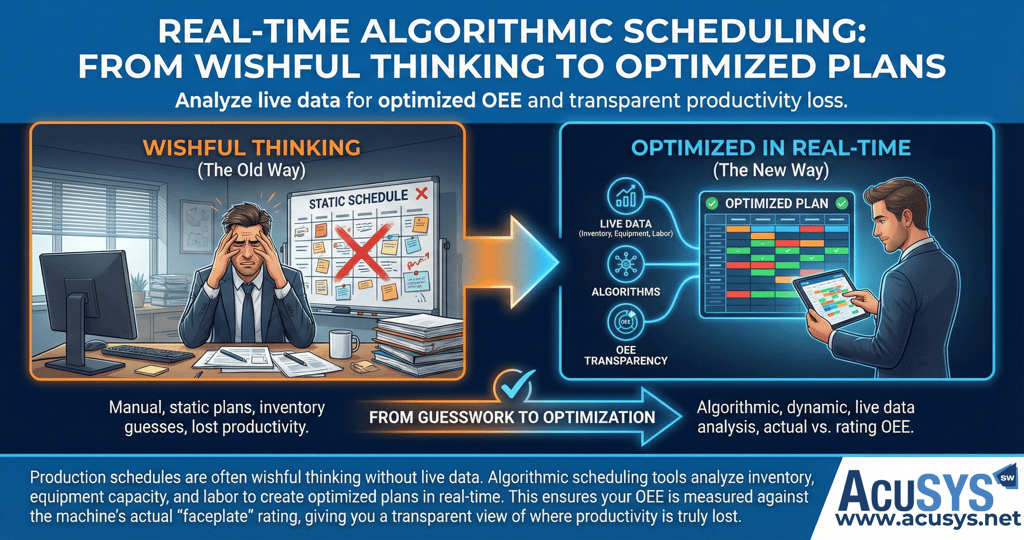
From Wishful Thinking to Precision: The Power of Algorithmic Scheduling
For many mid-level managers, the daily production schedule feels less like a plan and more like a "best-case scenario" that begins to unravel the moment the first shift starts. Without live data, scheduling is often just wishful thinking—based on static spreadsheets that don't account for a sudden material shortage, an unexpected labour gap, or a machine running at 80% capacity.
To achieve true operational resilience and prepare for AI, you need to move toward Real-Time Algorithmic Scheduling. This shifts the focus from reactive "firefighting" to a proactive model where the system balances inventory, capacity, and labour in real-time.
1. The "Faceplate" Reality: No More OEE Cheating
The first step in honest governance is measuring performance against reality. Many facilities "cheat" their OEE (Overall Equipment Effectiveness) by setting lower production speed targets to make their numbers look better.
How it helps: A robust MES ensures your Performance is measured against the "faceplate" rating—the theoretical maximum speed the manufacturer stamped on the side of the machine. By using TrakSYS, you gain a transparent view of where productivity is truly lost. When the data is pulled directly from the source via the TANI PLC Engine, you eliminate manual entry errors and uncover the "hidden DNA" of your production line, such as micro-stoppages that traditional reporting misses.
2. Algorithmic Production Scheduling (APS)
Standard scheduling assumes "infinite capacity," leading to overloaded work centres and missed deadlines. Algorithmic scheduling changes this by treating your factory as a dynamic system.
How it helps: TrakSYS Algorithmic Production Scheduling (APS) integrates directly with your ERP to create executable plans based on live constraints. It analyses:
Demand & Seasonality: Moving from reactive orders to proactive forecasting.
Capacity Planning: Evaluating available equipment and labour to determine if goals are actually attainable before you commit to a timeline.
Production Sequencing: Finding the most efficient job sequence to minimize changeover times and maximize throughput.
3. The Safety Net: Governance and Resilience
A high-performance schedule is only as good as the systems running it. If a PLC loses its logic or an unauthorized change occurs, even the best algorithm cannot save the shift.
How it helps: Octoplant provides the "governance" layer of your resilience strategy. It acts as an automated safety net, tracking "who changed what, when, and why" across your entire device landscape. If a system disruption occurs, Octoplant allows you to restore the "approved version" of your process logic in minutes, ensuring that your automated schedules are executed by validated, secure code.
4. Continuous Optimization and "What-If" Planning
The most powerful tool for a manager is the ability to see the future without risking the present.
How it helps: Through Scenario Analysis, you can use "what-if" planning to test how a rush order or a machine failure will ripple through your schedule. Solutions like SmartSights (OneView) provide a Goal Attainment Scenario Planning dashboard with sliders, allowing you to customize scenarios and view the projected impact on your OEE in real-time.
The Bottom Line: By moving to an algorithmic, data-driven execution model, you achieve "world-class" OEE (85%+) through consistent execution rather than shift-leader heroics. You stop chasing the schedule and start leading a resilient, predictable operation that is fully prepared for the next era of industrial AI.
Summary: This post explains how mid-level managers can move from "wishful thinking" to precise operational execution using Tier 4 Operations & Governance tools. It describes how TrakSYS uses algorithmic scheduling to balance real-time constraints like labor and inventory, while Octoplant ensures the resilience of the underlying control logic. By measuring OEE against true "faceplate" ratings and utilizing the TANI PLC Engine for data truth, managers can eliminate "OEE cheating" and achieve consistent, high-performance results.
Copyright 2026 AcuSYS Software Solutions (Pty) Ltd. All Rights Reserved.