
From Serial Cables to Smartphones: A Technician’s Guide to AI-Ready Connectivity
This blog post explores how you as a technicians can eliminate the manual "paper chase" by bridging legacy industrial hardware with modern, AI-ready technologies. It highlights how software solutions like TANI, atvise, and octoplant transform older PLCs and sensors into real-time digital assets, providing the shop floor with instant visibility and a reliable foundation for advanced diagnostics and future AI integration.
2/2/20262 min read
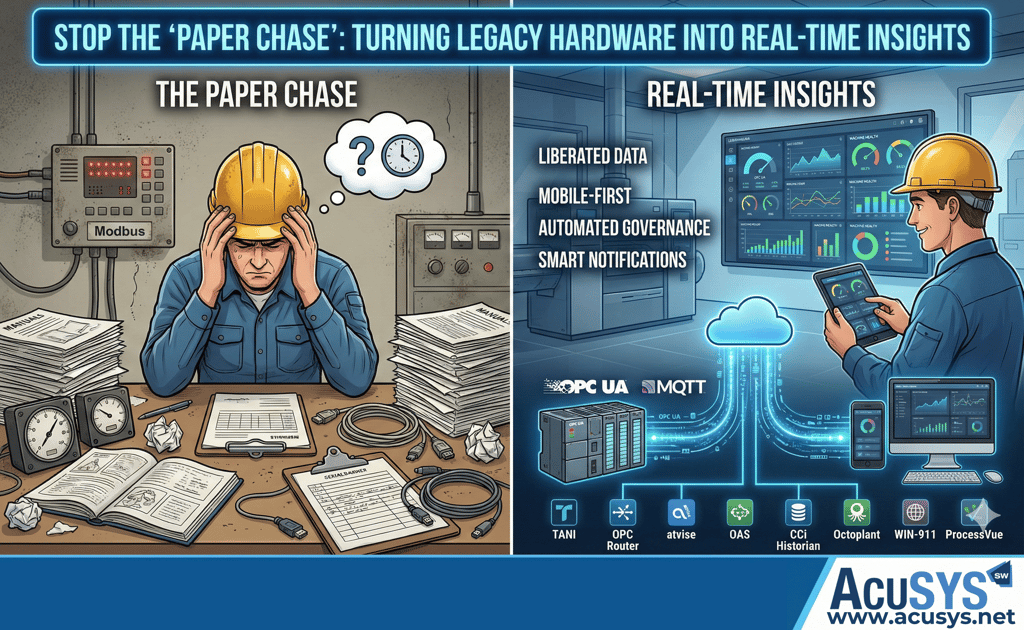
Stop the "Paper Chase": Turning Legacy Hardware into Real-Time Insights
If you’re a technician on the shop floor, you know the "paper chase" all too well. It’s the time wasted hunting for a specific serial cable, digging through a dusty manual to find a Modbus register address, or manually scribbling down meter readings for a shift report that might not even be read until tomorrow.
The biggest misconception about Industrial AI is that it requires a brand-new factory. In reality, the most successful AI implementations start by liberating the data from the legacy controllers—like Siemens S5 or older Modbus devices—already running on your floor.
Here is how you can stop chasing data and start using it to stay ahead of machine breakdowns.
1. Bridging the Gap: Legacy to Web
Preparing for AI doesn't mean replacing your reliable PLCs; it means giving them a modern voice. Tools like TANI (PLC Engine) and OPC Router act as your "multilingual translators".
How it helps: TANI can communicate natively with decades-old hardware (including Siemens S5 and Rockwell SLC/PLC5) and convert those "black box" protocols into modern OPC UA or MQTT streams. OPC Router then uses a visual, no-code workflow to bridge that data directly into your databases or cloud platforms. You get a continuous overview of production without writing a single line of custom code.
2. Seeing the Floor from Your Phone
Once your data is liberated, you shouldn't be tethered to a fixed terminal to see it. atvise and OAS (Open Automation Software) turn your process into a mobile-first experience.
How it helps: atvise is 100% web-based SCADA. Because it uses native HTML5 and vector graphics (SVG), you can pull up your HMI on any browser—smartphone, tablet, or laptop—and it will scale perfectly without any loss of definition. Similarly, the OAS Platform provides a "Universal Data Connector" that lets you build native mobile apps to monitor and control data from any source on one screen.
3. The End of Manual Logbooks
When a machine crashes at 3 AM, the first question is always: "What changed?" Instead of flipping through paper logs, a high-performance historian provides the "ground truth."
How it helps: CCi Historian retrieves data at a staggering 70 million values per second—10 to 1,000 times faster than traditional systems. Its "CCI Plot" feature acts as a visual logbook, allowing you to annotate trend plots with your own comments and save them into the database. You can search for these annotations later to see exactly how a similar issue was resolved six months ago.
4. Your Operational Safety Net
Human error and hardware failure are facts of life. AI-ready operations protect against these through automated governance.
How it helps: Octoplant acts as your safety net by providing automated backups and version control for your PLCs and SCADA systems. It tracks "who changed what, when, and why". If a program is accidentally overwritten or a PLC fails, you can restore the "approved version" in minutes with a couple of clicks, rather than spending hours troubleshooting an old backup.
5. Smart Notifications, not "Alarm Fatigue"
You don't need more alarms; you need the right alerts. WIN-911, SmartSights Mobile, and ProcessVue ensure you only respond to what matters.
How it helps: WIN-911 and SmartSights deliver prioritized, real-time notifications via SMS, voice, or a secure mobile app. To prevent "alarm floods," ProcessVue analyses the Sequence of Events (SOE) to help you find the root cause of an upset and identify "bad actor" alarms that are cluttering your day.
The Bottom Line: By combining these tools, you move from reactive troubleshooting to proactive maintenance. You spend less time entering data and more time using it to keep the plant running at world-class efficiency.
Copyright 2026 AcuSYS Software Solutions (Pty) Ltd. All Rights Reserved.