
Architecture Over “Spaghetti”: Why a Unified Namespace is the Only Way to Scale
This post explores how System Integrators can eliminate technical debt—which currently consumes up to 80% of industrial IT budgets—by moving away from brittle, point-to-point "spaghetti" integrations. We dive into the architectural shift toward the Unified Namespace (UNS), a central nervous system where legacy and modern systems publish data once for any authorized application to subscribe to.
2/5/20262 min read
Architecture Over “Spaghetti”: Why a Unified Namespace is the Only Way to Scale
For System Integrators, technical debt is the silent killer of innovation. Research shows that nearly 70% to 80% of IT budgets are consumed simply by keeping existing systems alive, leaving minimal room for the digital transformation your clients actually want.
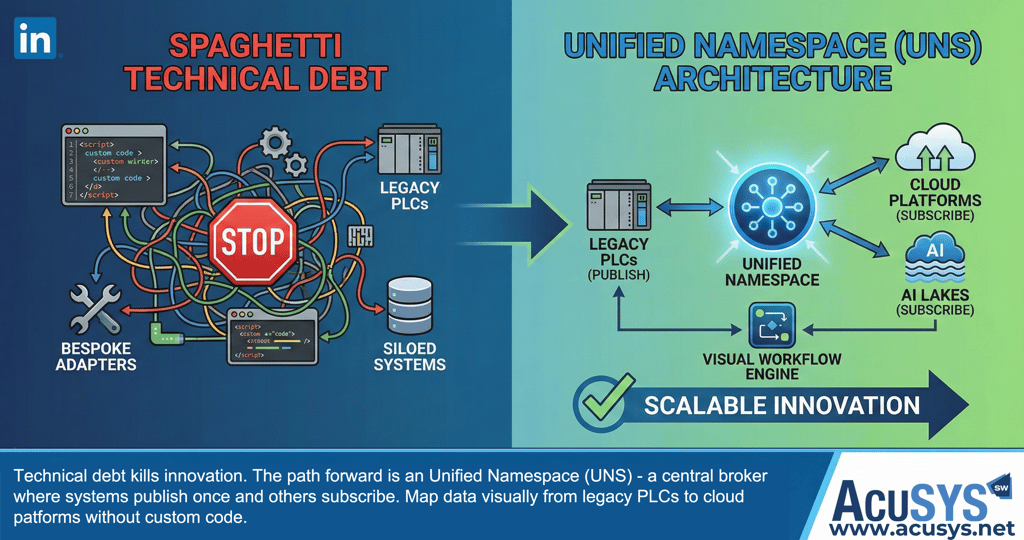
When every new AI model or cloud integration requires a bespoke, point-to-point adapter, you aren't building a scalable solution—you’re cooking "spaghetti architecture." This brittle approach makes even simple changes require detective work and increases the risk of unintended consequences whenever a system is updated.
The path forward is the Unified Namespace (UNS). This architectural shift moves us away from the rigid, linear hierarchies of the traditional automation pyramid toward an event-driven "central nervous system" for the factory.
The Power of Publish and Subscribe
In a UNS, systems are decoupled. Instead of a PLC talking directly to a SCADA, which talks to an MES, every system communicates with a central broker. Devices publish their data once—fully contextualized according to industry standards like ISA-95—and any authorized application (historian, AI model, or dashboard) simply subscribes to that stream.
By using visual workflow engines, you can map data from legacy PLCs to cloud platforms or AI lakes without writing custom code. This reduces the "Technical Paradox" where facilities generate terabytes of data but starve for actionable insights because that data is trapped in silos.
How Our Software Solutions Build Your Digital Core
To move from bespoke adapters to a scalable UNS, you need a toolkit that handles protocol translation, data movement, and visual orchestration.
TANI (PLC Engine): Acts as your high-performance "multilingual translator." It provides the first mile of connectivity by reading data from legacy Siemens S5, Modbus, or modern S7-1500 controllers and converting it into semantic-rich OPC UA or MQTT messages. It is optimized for speed, reading complex data structures as objects rather than single variables to reduce network load.
OPC Router: This is the orchestrator of your visual workflow. It provides a no-code, drag-and-drop interface to connect your OT systems to IT platforms like SAP, SQL, or Snowflake. It allows you to automate data flows and trigger actions in real-time based on PLC events, ensuring that your UNS is always populated with the right data at the right time.
OAS (Open Automation Software): A highly flexible data platform that serves as a Universal Data Connector. It enables the seamless movement and transformation of data between IoT devices, databases, and custom.NET applications. Its distributed architecture supports edge computing, allowing you to filter or process data before it ever hits the central namespace.
atvise® SCADA: Breaks down the rigid automation pyramid by providing a 100% web-native interaction hub based on OPC UA. It acts as a central data hub that can obtain, process, and forward information to higher-level systems, allowing you to visualize your entire Unified Namespace from any browser on any device.
The Result: By replacing "spaghetti" with a Unified Namespace supported by these tools, you can reduce integration costs by as much as 50% and deliver AI-ready data in weeks rather than months.
Summary: This post explains why System Integrators must move away from point-to-point "spaghetti" integrations toward a Unified Namespace (UNS). By leveraging a publish/subscribe model and visual workflow tools, SIs can decouple hardware from software and eliminate technical debt. The post highlights how TANI, OPC Router, OAS, and atvise work together to create a scalable, no-code data core that bridges the gap between legacy shop-floor assets and modern AI-driven cloud platforms.
Copyright 2026 AcuSYS Software Solutions (Pty) Ltd. All Rights Reserved.